Bhavesh
Nathwani.
Senior Data Analyst
Senior Data Analyst with 7+ years building central data functions from scratch in high-growth startups. I combine deep commercial analytics with modern AI, having recently completed an MSc in Applied Data Science & AI with Distinction.

Oversaw all end-to-end data analytics, infrastructure and insights across a 5.5-year tenure, supporting the business through multiple funding rounds, a strategic competitor acquisition and growth from 3,000 to over 1 million users.
Promoted to full ownership of data strategy, infrastructure, engineering and analytics. Served as core data stakeholder during the acquisition of Canopy's largest competitor.
- Published the data architecture and methodologies behind Canopy's Rental Affordability Index, cited 400+ times by the BBC, Sky News and The Independent. Significantly drove brand authority and organic reach.
- Led post-acquisition data integration: mapped and reconciled highly complex, disparate operational datasets from both companies to create a single source of truth for company-wide KPIs and reporting.
- Overhauled core data infrastructure via a major migration from Google BigQuery and AWS Redshift to PostgreSQL, reducing pipeline processing times by 90%.
- Drove adoption of the company's self-serve analytics framework, empowering cross-functional teams to build their own reports, cutting ad-hoc data requests by 75%+.
- Mentored a Junior Data Analyst through to a Principal Data Analyst contract at the BBC. Established company-wide data governance, integrity checkpoints and automated reconciliation frameworks.
Appointed as the first data hire, architecting and launching Canopy's central data function from scratch.
- Evaluated and overhauled the BI tech stack, migrating from vendor-implemented AWS QuickSight to Metabase, a more intuitive, cost-effective and scalable solution.
- Built scalable reporting infrastructure, automating weekly, monthly and quarterly operational insight loops that removed manual bottlenecks and improved leadership forecasting accuracy.
- Introduced predictive modelling and cohort analysis to evaluate user behaviour, identify churn risks and surface expansion opportunities for product and marketing teams.
 SQL
SQL Python
 PostgreSQL
 BigQuery
 Metabase
 Redshift
 Google Cloud
 AWS
AWS Dataform
 n8n
n8n Power Automate
 Apps Script
 Google Sheets
 Excel
Excel Automation
 Claude
Appointed to support clients in leveraging data for strategic decision-making, bridging the gap between raw data and actionable insights. Operated in a consultant capacity, working directly with stakeholders to deliver tailored analytics solutions.
- Led end-to-end data projects from scoping and requirements gathering through to delivery, ensuring high-impact, client-ready outputs.
- Developed and automated data workflows using SAS, SQL (SQL Server, MySQL, Snowflake) and Python, incorporating basic machine learning models.
- Designed interactive dashboards and visualisations in Tableau, Excel and Python, transforming complex datasets into clear, actionable insights.
- Delivered well-documented analytical outputs ensuring clients had a thorough understanding of methodology and outcomes.
SQLPython Tableau
 SAS
SAS Snowflake
OPIT – Open Institute of Technology
Dissertation: My dissertation focused on building a hybrid human-AI system to automatically discover undeclared foreign key relationships in large-scale relational databases, a problem that sits at the heart of AI-powered data discovery and database automation.
Read about my dissertation →Modules:
The University of Manchester
Hindu Society · Mathematics Society · PASS Leader · UoM Buddy Scheme
Year 1:
Year 2:
Year 3:
SQLPythonPostgreSQLBigQueryMetabaseRedshiftGoogle CloudAWSDataformn8nPower AutomateApps ScriptGoogle SheetsExcelAutomation SQLAlchemy
 OpenAI API
 SQLite
 pandas
 scikit-learn
 RichClaude
Evaluating Hybrid Human-AI Systems for Discovering Undeclared Foreign Key Relationships in Large-Scale Relational Databases
Built entirely in Python, evaluated on real open-source data.
PythonPostgreSQLSQLAlchemyOpenAI API (GPT-4)SQLitepandasscikit-learnRichForeign keys are missing. Nobody notices until it's too late.
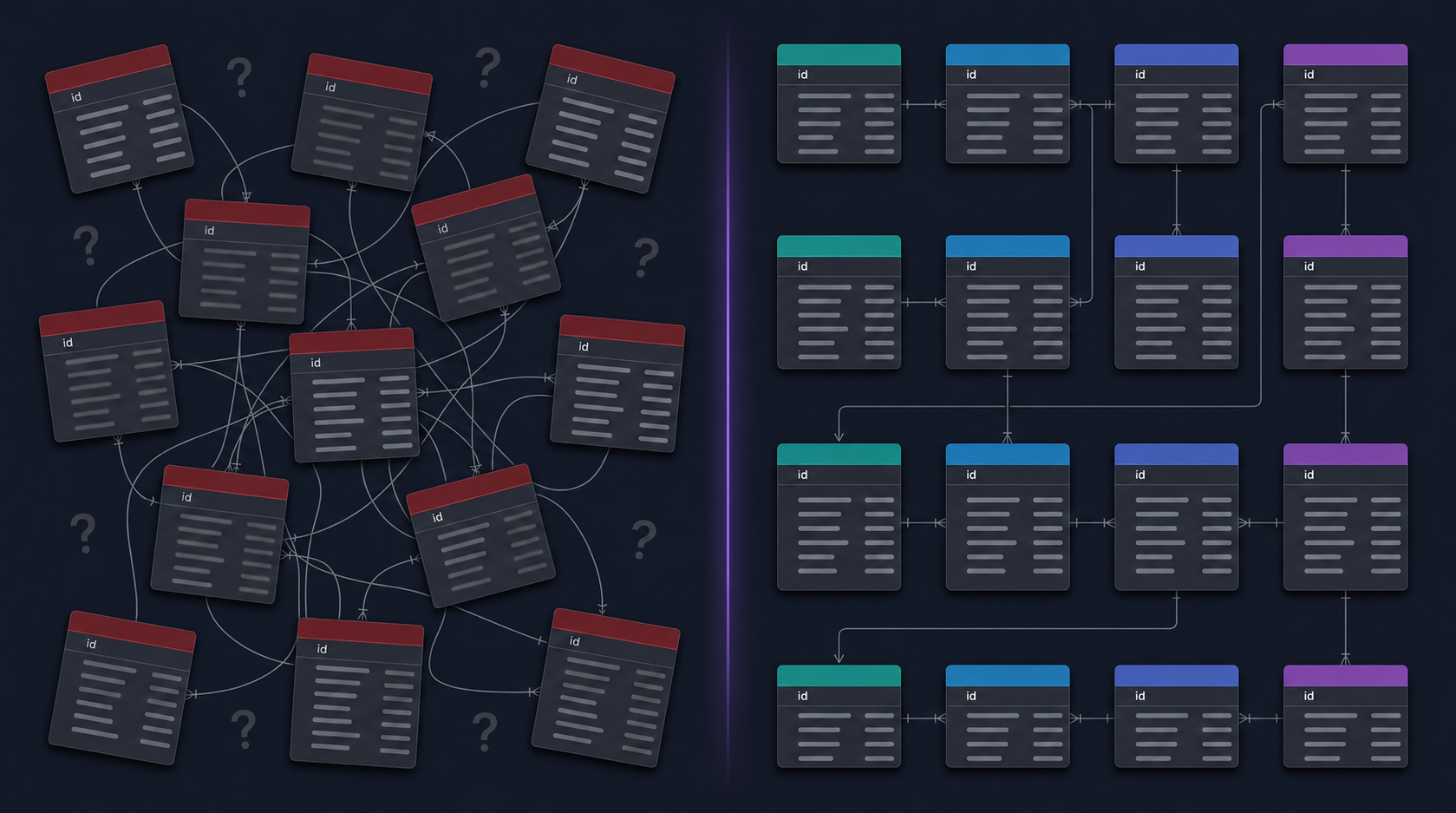
Example of a real-world database with missing foreign key documentation
Foreign key relationships are the backbone of any relational database. In enterprise environments, they are frequently dropped for performance reasons, lost during migrations, or simply never documented in legacy systems.
A database with 1,800 columns has over 3 million possible column pair combinations. Finding the meaningful ones manually is not realistic. My dissertation asked whether a system could do it automatically, at scale, with enough accuracy to be trusted.
A six-step pipeline combining statistics, naming patterns and human expertise.
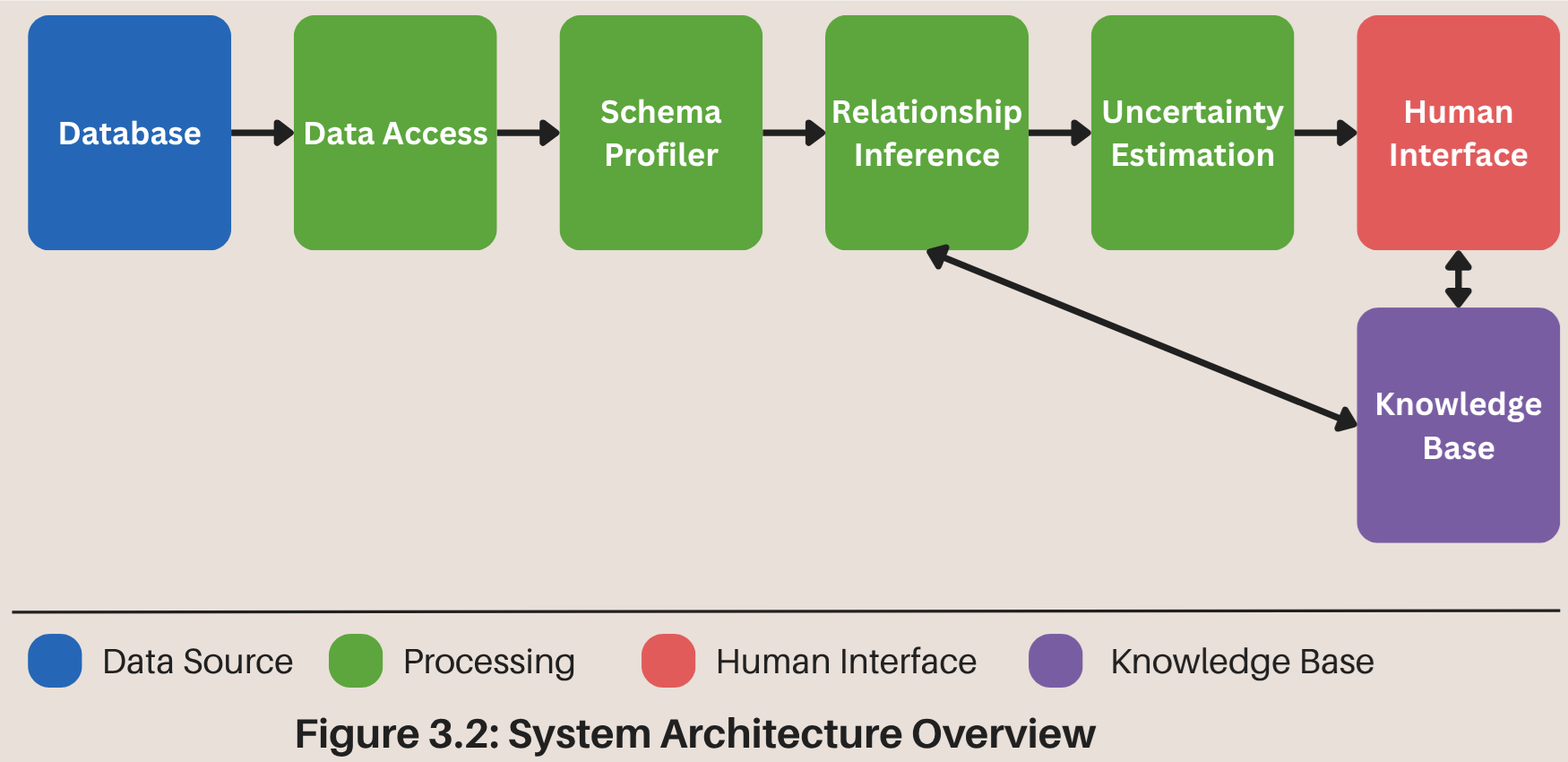
Every decision is explainable. No black boxes.
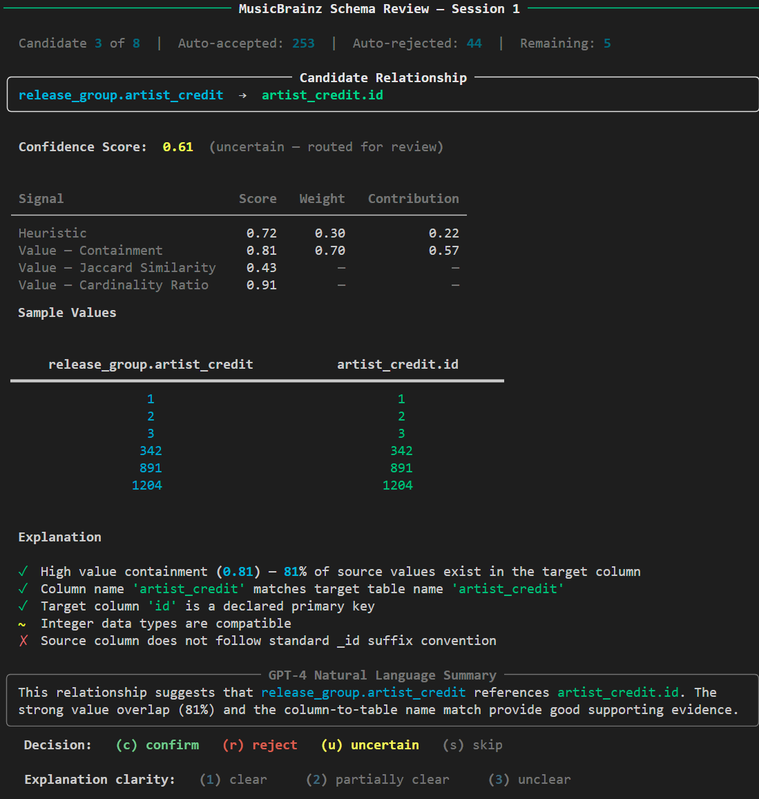
Human Review Interface: CLI screenshot
The centrepiece of the system is a CLI tool that presents uncertain candidates to a reviewer with full context: confidence score, signal breakdown, sample values from both columns side by side, and a plain-English explanation generated by GPT-4.
Reviewers are never shown a black box score. Every decision is fully explainable, with GPT-4 generating a plain-English rationale for each candidate surfaced for review.
92.64% F1: over 15 percentage points above either signal alone.
| Configuration | F1 Score |
|---|---|
| Name matching only | 76.90% |
| Value analysis only | 78.61% |
| Combined (final system) | 92.64% |
The system was evaluated against 310 known foreign key relationships in MusicBrainz, a real open-source music database with 368 tables and 238 million rows. Testing each component in isolation revealed how much each signal contributed.
Neither signal alone was sufficient. Combined, they produced a result over 15 percentage points higher than either individually.
entity0 instead of artist_id. These could not be matched by name-based patterns, accounting for the majority of missed relationships.A quarterly report on UK rental affordability, published at Canopy. Cited by over 80 national and regional news outlets including the BBC, Financial Times, Sky News, The Telegraph and Daily Mail.